


Understanding Asset Protection Trusts: Why They Matter for Your Wealth
Asset protection trusts are specialized legal tools designed to shield your wealth from creditors, lawsuits, and other financial claims. Think of them as a legal firewall between you and potential threats to your assets—one that, when properly structured, makes it extremely difficult for creditors to access what you've worked hard to build.
Quick Answer: What You Need to Know About Asset Protection Trusts
- Definition: An irrevocable trust that holds your assets to protect them from future creditor claims
- How It Works: You transfer assets to a third-party trustee who manages them on behalf of beneficiaries (which can include you)
- Key Benefit: Assets in the trust are legally separate from your personal ownership, shielding them from lawsuits and judgments
- Important Requirement: The trust must be irrevocable—you cannot easily change or revoke it
- Who Benefits: High-risk professionals, business owners, high-net-worth individuals, and anyone concerned about future liability
- Timing Matters: Must be established before legal claims arise to be effective
While a standard revocable living trust helps with estate planning, it offers no protection from creditors. An Asset Protection Trust (APT) is fundamentally different. It's an irrevocable structure where you transfer ownership of assets to a trustee. Because you no longer legally own these assets, creditors generally cannot seize them.
The protection comes from separating legal ownership from beneficial enjoyment. You may still benefit from the trust's assets (as a beneficiary), but you don't control them directly. This legal separation creates the shield.
However, APTs are not magic bullets. They must be set up years in advance to avoid fraudulent conveyance laws, are complex to establish, and require giving up direct control. They also have strict legal and tax requirements that vary by jurisdiction. Despite these complexities, for high-risk professionals, business owners, and high-net-worth families, the security an APT provides is often invaluable.
The information contained in this blog is provided for general informational purposes only and does not constitute accounting, tax, legal, or investment advice. The content is not intended to be a substitute for professional advice tailored to your specific circumstances.
How an Asset Protection Trust Works to Shield Your Wealth
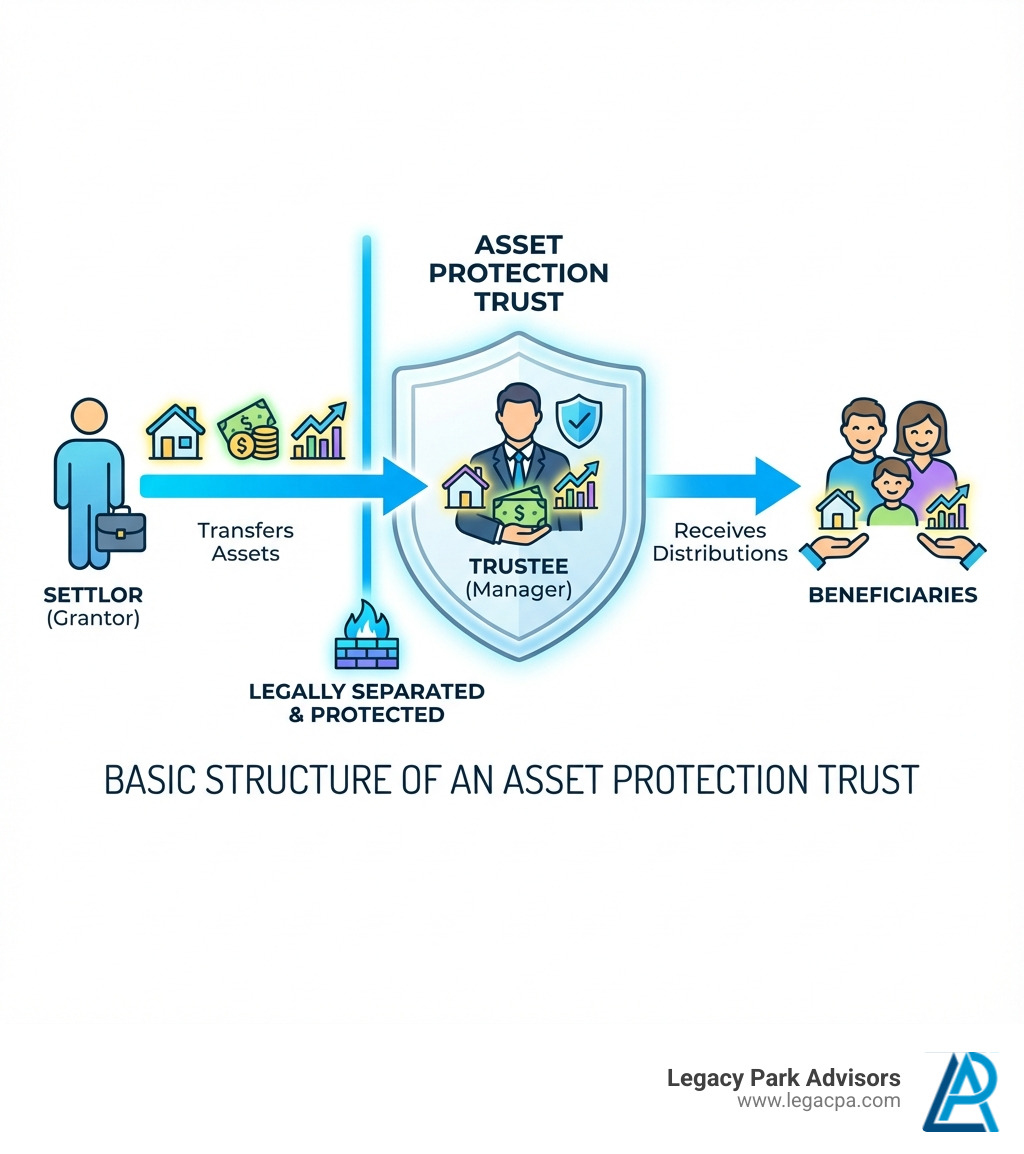
An Asset Protection Trust works by legally separating you (the "grantor" or "settlor") from your assets. Once transferred into a properly structured APT, assets are no longer your personal property and are generally beyond the reach of creditors or lawsuits. The trust, through its trustee, legally owns and manages the assets for designated beneficiaries, creating a powerful protective shield.

Key Players: The Settlor, Trustee, and Beneficiary
Understanding the roles within an APT is crucial to grasping how it functions:
- Settlor (or Grantor): The person who creates the trust and transfers assets into it. To ensure protection, the settlor cannot retain control over the assets.
- Trustee: The individual or entity legally responsible for managing the trust assets per the trust's terms. The trustee must be independent and not under the settlor's control, with a fiduciary duty to act in the beneficiaries' best interests.
- Beneficiary: The individuals or entities designated to receive benefits from the trust. The settlor can be a beneficiary, but distributions must be at the trustee's discretion, not guaranteed.
Irrevocable vs. Revocable: The Key to Protection
The key to an APT's power is its irrevocability.
- Irrevocable Trusts: Once created, an irrevocable trust generally cannot be changed or revoked by the grantor. This permanence is what provides protection. Since you no longer have the power to take the assets back, creditors cannot force you to do so. This relinquishment of control is the cornerstone of an APT. You can learn more in our guide on Irrevocable Trusts Explained: How They Work, Types, and Uses.
- Revocable Trusts: In contrast, a revocable (or living) trust can be changed at any time by the grantor. While useful for probate avoidance, this retained control means the assets are still considered yours for creditor purposes, offering no asset protection.
The "Spendthrift" Clause and Its Limits
A "spendthrift" clause is a provision that protects a beneficiary's interest from their creditors. It prevents the beneficiary from selling their interest and stops creditors from seizing future distributions. However, these clauses have limits. They may not be effective in "self-settled trusts" (where you are the creator and beneficiary) against your own creditors in many jurisdictions. Courts may also override them for certain debts like alimony or child support. Most importantly, if assets are transferred to defraud existing creditors, the entire trust can be challenged under fraudulent transfer laws, highlighting the need for proactive planning.
The information contained in this blog is provided for general informational purposes only and does not constitute accounting, tax, legal, or investment advice. The content is not intended to be a substitute for professional advice tailored to your specific circumstances.
Types of APTs: A Comparison of Domestic vs. Foreign (Offshore)
When considering an Asset Protection Trust, one of the most significant decisions you'll face is whether to establish a domestic (U.S.-based) or foreign (offshore) trust. Both have their advantages and disadvantages, and the best choice depends heavily on your specific circumstances, risk tolerance, and the level of protection you seek.
| Feature | Domestic Asset Protection Trust (DAPT) | Foreign (Offshore) Asset Protection Trust (FAPT) |
|---|---|---|
| Jurisdiction | Established in specific U.S. states with DAPT statutes. (Not in California) | Established in foreign countries with strong asset protection laws. |
| Cost | Generally lower setup and maintenance costs ($2,000 - $5,000+ setup). | Significantly higher setup and maintenance costs ($20,000 - $50,000+ setup). |
| Protection Level | Strong, but still within U.S. legal system; vulnerable to federal courts. | Potentially stronger, outside U.S. court jurisdiction; greater problems for creditors. |
| Privacy | Varies by state; generally less private than offshore. | Often offers improved privacy and confidentiality. |
| Legal System | Governed by U.S. state and federal laws. | Governed by foreign laws, often designed to be creditor-unfriendly. |
| Asset Location | Assets typically remain within the U.S. | Assets can be held in foreign accounts, further complicating creditor access. |
What is a Domestic Asset Protection Trust (DAPT)?
A Domestic Asset Protection Trust (DAPT) is an irrevocable trust established in one of the U.S. states with specific enabling legislation (at least 20 states as of 2024). These trusts allow the settlor to be a discretionary beneficiary while still protecting assets from creditors.
Crucially, California does not permit DAPTs. A California resident could establish a DAPT in another state (like Alaska or Nevada), but its effectiveness could be challenged in a California court, which might not recognize the other state's protective laws.
- Pros: Lower cost, operates within the familiar U.S. legal system, and avoids complex foreign tax reporting.
- Cons: Assets remain within the U.S. legal system, making them vulnerable to federal courts. The law is still evolving, and many DAPT statutes have exceptions for certain creditors (e.g., child support, alimony). For California residents, the risk of a local court disregarding the trust is significant.
Expert legal counsel is essential to steer these potential conflicts of law. You can read more about Asset Protection Trusts generally.
What is a Foreign (Offshore) Asset Protection Trust?
A Foreign (Offshore) Asset Protection Trust (FAPT) is an irrevocable trust established outside the United States, in jurisdictions like the Cook Islands, Nevis, or Belize. These countries have laws specifically designed to make it extremely difficult for foreign creditors to reach trust assets.
- Pros: Generally offer stronger protection, as creditors must litigate in a foreign court under foreign laws, which is expensive and challenging. They also provide greater privacy and a strong deterrent effect.
- Cons: Significantly higher costs and complexity. They require relinquishing control to a foreign trustee and are subject to rigorous IRS reporting to prevent their use in abusive tax evasion schemes.
For Californians with substantial wealth and risk, an FAPT may offer a superior level of protection, but requires experienced guidance to ensure compliance. Learn more from this Domestic vs Offshore Asset Protection Trusts: A Basic Guide.
Special Use Case: The Medicaid Asset Protection Trust (MAPT)
A Medicaid Asset Protection Trust (MAPT) is a specialized irrevocable trust designed to help individuals qualify for long-term care benefits through Medicaid while preserving assets for their family. By transferring assets into an MAPT, they are no longer counted for Medicaid's strict eligibility limits.
Key considerations include:
- 5-Year Look-Back Period: Assets transferred into an MAPT within five years of applying for Medicaid can trigger a penalty period, delaying benefits. Proactive planning is essential.
- Estate Recovery Protection: Assets held in a properly structured MAPT are generally protected from Medicaid estate recovery, which is the process states use to recoup long-term care costs from a deceased recipient's estate. You can find more information on Medicaid estate recovery.
An MAPT requires careful planning with an experienced elder law attorney.
The information contained in this blog is provided for general informational purposes only and does not constitute accounting, tax, legal, or investment advice. The content is not intended to be a substitute for professional advice tailored to your specific circumstances.
The Practical Guide to Establishing an Asset Protection Trust
Establishing an Asset Protection Trust is a sophisticated legal strategy requiring expert guidance. A critical principle is proactive planning. An APT must be created and funded well before any claims arise. Transferring assets when a lawsuit is pending can be deemed a "fraudulent conveyance," undoing the trust's protections. Timing is everything.
Who Typically Benefits from an APT?
While not exclusively for the ultra-wealthy, certain individuals and families in California often find an Asset Protection Trust particularly beneficial due to their exposure to higher risks:
- High-Risk Professionals: Doctors, dentists, attorneys, architects, and other professionals who face a higher likelihood of malpractice lawsuits or professional liability.
- Business Owners: Entrepreneurs and business owners, especially those with significant personal guarantees or exposure to business-related debts and lawsuits.
- High-Net-Worth Individuals: Those with substantial assets who want to safeguard their wealth from unforeseen future judgments, creditors, or financial disputes.
- Real Estate Investors/Developers: Individuals involved in ventures that carry inherent risks and potential for litigation.
- Individuals Concerned About Future Lawsuits: Anyone who foresees potential future claims, perhaps due to their profession, investments, or personal circumstances, and wishes to proactively shield their assets.
Key Steps to Establish and Fund Your Trust
The process involves several key steps guided by your legal and tax advisors:
- Consultation and Strategy: Determine if an APT is the right tool for your situation and goals.
- Jurisdiction Selection: Choose the appropriate location for the trust (e.g., a specific U.S. state or an offshore jurisdiction), a critical decision for California residents.
- Trust Drafting: Create a comprehensive legal document outlining the trust's terms, beneficiaries, and trustee powers.
- Trustee Selection: Appoint an independent, third-party trustee (often a professional trust company) to manage the trust.
- Asset Funding: Formally transfer assets—such as real estate, investments, or cash—into the trust to legally separate them from your personal ownership.
Understanding the Costs: Setup and Maintenance
The costs of an APT reflect its complexity.
- Domestic APTs: Legal setup fees for a DAPT (in a state that permits them) typically range from $2,000 to $5,000+.
- Foreign (Offshore) APTs: These are significantly more expensive, with setup costs often ranging from $20,000 to $50,000, plus substantial annual administration and management fees.
While these costs are significant, they are often considered a worthwhile investment for those with substantial assets or high liability risk.
The information contained in this blog is provided for general informational purposes only and does not constitute accounting, tax, legal, or investment advice. The content is not intended to be a substitute for professional advice tailored to your specific circumstances.
Navigating the Legal and Tax Implications
Properly structuring an Asset Protection Trust is critical for both effective protection and compliance with complex legal and tax rules.
U.S. Tax Rules and Reporting Requirements
For U.S. tax purposes, most APTs are structured as "grantor trusts." This means the trust's income is reported on your personal tax return (Form 1040), making the trust "tax neutral." The goal is asset protection, not tax avoidance. For foreign trusts, strict reporting is required via IRS Form 3520. It is crucial to distinguish legitimate APTs from illegal tax evasion schemes. The IRS warns against abusive trust arrangements that falsely claim to eliminate tax liability while the grantor retains control.
International Tax Complexities
Offshore APTs add another layer of complexity. While the U.S. grantor trust rules typically apply, you must also steer the laws of the foreign jurisdiction. Each country has its own intricate tax rules, underscoring the need for specialized advice when engaging in international planning. For example, other countries have rules like Canada's 21-year deemed disposition rule, which highlights the diverse global landscape.
Protection from Divorce and Family Law Claims
An APT's ability to shield assets in a divorce is nuanced, especially in a community property state like California. Generally, assets transferred to the trust before marriage are considered separate property and receive stronger protection. For the trust to be effective, it must be fully discretionary, meaning the beneficiary spouse has no guaranteed right to distributions. If trust funds are co-mingled with marital assets (e.g., deposited into a joint account), they can lose their protected status. Courts will scrutinize trusts created shortly before or during a marriage, so proactive planning is paramount.
The information contained in this blog is provided for general informational purposes only and does not constitute accounting, tax, legal, or investment advice. The content is not intended to be a substitute for professional advice tailored to your specific circumstances.
Frequently Asked Questions about Asset Protection Trusts
We understand that Asset Protection Trusts can seem complex. Here are answers to some of the most common questions we hear:
Can I be the trustee of my own asset protection trust?
No. For an Asset Protection Trust to be effective, you must relinquish control. Serving as your own trustee would allow a court to disregard the trust and give creditors access to the assets. An independent, third-party trustee is required to ensure the assets are legally separate and protected.
How quickly does an APT protect my assets?
Protection is not immediate. A "seasoning period" (statute of limitations) must pass before assets are fully shielded. This period varies by jurisdiction but is typically two to four years for domestic trusts. Transferring assets just before or after a claim arises can be challenged as a fraudulent conveyance, which could invalidate the trust. This is why establishing an APT well in advance of any potential issues is critical.
Are asset protection trusts only for the ultra-wealthy?
Not exclusively. While common for the wealthy, APTs are also highly beneficial for professionals in high-risk fields (doctors, lawyers), business owners with personal guarantees, and anyone with substantial assets they wish to protect from future, unforeseen liabilities. The decision depends more on your risk profile and goals than on a specific net worth number.
The information contained in this blog is provided for general informational purposes only and does not constitute accounting, tax, legal, or investment advice. The content is not intended to be a substitute for professional advice tailored to your specific circumstances.
Conclusion: Securing Your Financial Legacy with the Right Strategy
An Asset Protection Trust is a sophisticated and powerful tool for safeguarding your wealth against the unpredictable challenges of life, from lawsuits and creditor claims to the complexities of family law. While it demands careful planning, a relinquishment of control, and often a significant investment, the peace of mind and security it provides can be invaluable for individuals and families in California.
The journey to effective asset protection is one of proactive strategy, not reactive defense. It requires a deep understanding of complex legal and tax implications, whether you're considering domestic options (if applicable in other states) or the robust protections offered by offshore jurisdictions.
At Legacy Park Advisors, we believe in a collaborative, client-centric approach. We work diligently to understand your unique circumstances, risk tolerance, and long-term financial goals. Our expertise in tailoring tax planning strategies extends to helping you explore and implement the most effective asset protection solutions, ensuring your financial legacy is secured and positioned for growth for generations to come.
Don't wait for a crisis to consider protecting what you've worked so hard to build. Let us help you design a comprehensive strategy that provides a legal firewall around your assets, offering you confidence and control over your financial future.
Explore our services to build your financial legacy.
The information contained in this blog is provided for general informational purposes only and does not constitute accounting, tax, legal, or investment advice. The content is not intended to be a substitute for professional advice tailored to your specific circumstances.