


The Dawn of the Great Wealth Transfer
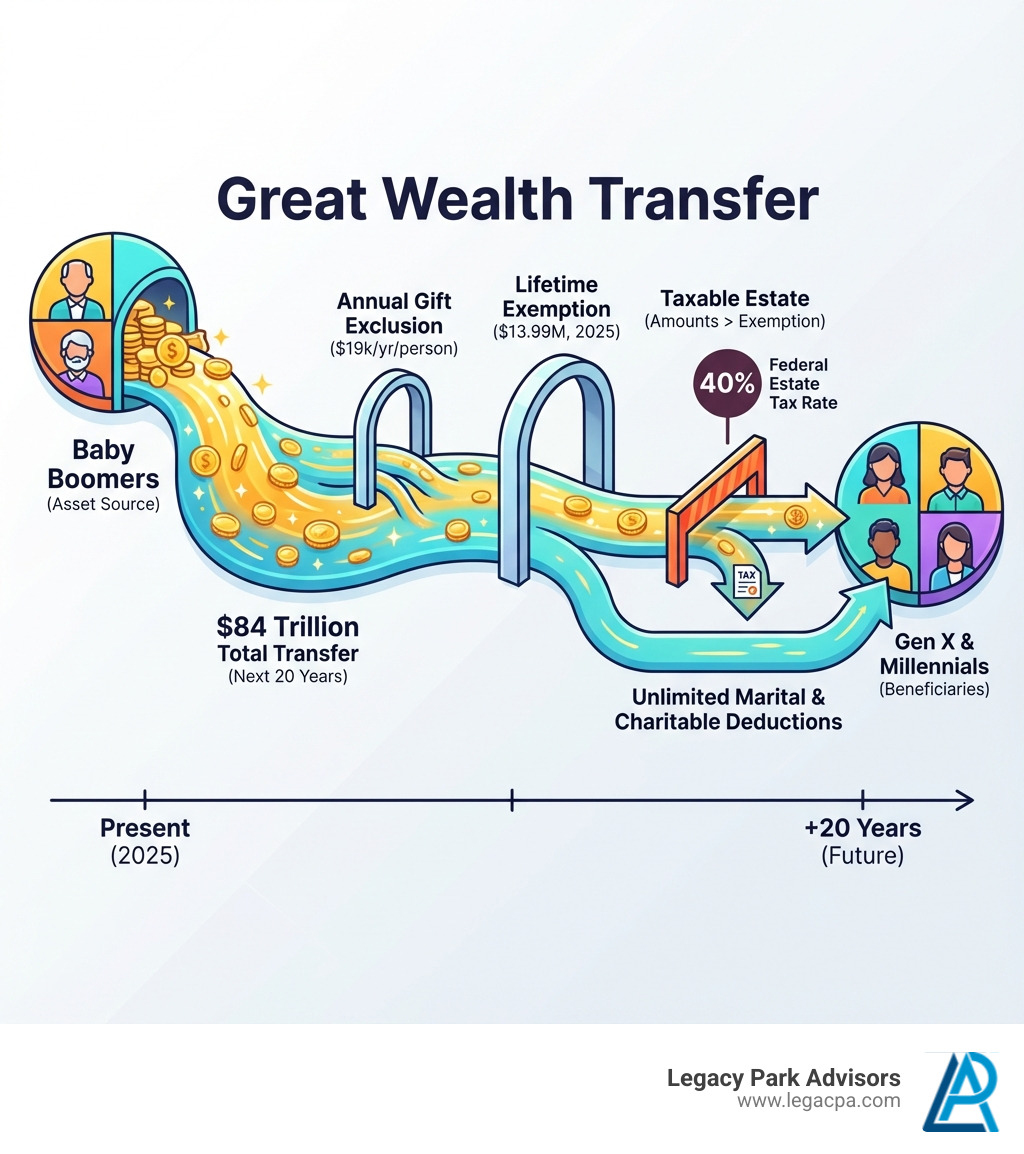
Family wealth transfer is the process of passing assets from one generation to the next, either during your lifetime through gifts or after death through inheritance. Over the next 20 years, more than $84 trillion will transition as Baby Boomers transfer their wealth—making this the largest generational shift of wealth in modern history.
Quick Overview: Family Wealth Transfer Essentials
- Two Primary Methods: Gift assets during your lifetime or leave an inheritance at death
- 2026 Lifetime Exemption: Transfer up to $15 million without federal gift or estate taxes
- Annual Gift Exclusion: Give up to $19,000 per person per year without using your lifetime exemption
- Estate Tax Rate: 40% federal tax applies to amounts exceeding the exemption
- Special Exemptions: Unlimited marital deduction for spousal transfers; charitable deductions for qualified charities
Wealth transfer is about more than money; it's about preserving your family's values and long-term vision. Yet research shows that two-thirds of wealthy families lose their fortune by the second generation—often due to poor planning and lack of communication.
The stakes are high. Over 1.2 million people with a net worth above $5 million are expected to collectively pass on almost $31 trillion over the next 10 years. Understanding the fundamentals of family wealth transfer is essential, whether you're a Boomer preparing to give, a Gen Xer inheriting, or a Millennial planning ahead.
This guide covers the core mechanics, tax implications, and strategies for preserving your assets and family harmony. We'll cover federal exemptions, annual exclusions, succession planning, and the critical role of communication.
The Core Mechanics: Gifting vs. Inheritance
At the heart of family wealth transfer are two primary pathways: gifting during your lifetime or leaving an inheritance at death. Each method has unique rules and tax implications. At Legacy Park Advisors, we help you steer these options to align with your family's long-term vision.
When we talk about tax liabilities, we're primarily looking at federal gift and estate taxes. While complex, the government provides generous exemptions and exclusions to help families minimize their tax burden.
Understanding Federal Gift and Estate Taxes
The federal government offers a combined lifetime exemption for gift and estate taxes. This means you can transfer a certain amount of wealth—either through lifetime gifts or as part of your estate—without incurring federal taxes. For 2025, this exemption is a substantial $13.99 million per individual, allowing many families to transfer wealth entirely tax-free.
The federal estate tax rate is a flat 40% on any amount exceeding this exemption. Careful planning can help most families avoid or significantly reduce this tax.
How does the exemption work? Imagine it as a large bucket. Every taxable gift you make during your lifetime (gifts exceeding the annual exclusion) chips away at this $13.99 million lifetime exemption. Whatever remains at your death is applied to your estate. For example, if you made $3 million in taxable lifetime gifts, you would have $10.99 million of your 2025 exemption remaining to apply to your estate. This shows how lifetime gifting directly impacts estate planning.
Leveraging the Annual Gift Exclusion
Separate from the lifetime exemption is the annual gift exclusion, a powerful tool for tax-efficient family wealth transfer. For 2026, this exclusion allows you to gift up to $19,000 per individual each year without incurring gift tax or using your lifetime exemption.
The beauty of this exclusion is its "per-person" nature. You can give $19,000 to your child, another $19,000 to your grandchild, and so on, all in the same year. If you're married, you and your spouse can each make these gifts, effectively doubling the amount to $38,000 per recipient annually.
This is a "use-it-or-lose-it" benefit each year, allowing for significant wealth transfer over time without ever filing a gift tax return. If you gift more than the annual exclusion (e.g., $20,000 in 2026), the excess ($1,000) simply reduces your lifetime exemption. You don't pay tax immediately, but it reduces the amount you can transfer tax-free later.
Special Tax-Advantaged Transfers
Beyond general exemptions, certain transfers receive special tax treatment, making them valuable for strategic family wealth transfer.
First, transfers to a U.S. citizen spouse benefit from the unlimited marital deduction. You can transfer an unlimited amount of assets to your spouse during your lifetime or at death without federal gift or estate tax. This is a cornerstone of estate planning for married couples, allowing for the deferral of estate taxes until the second spouse's death.
Second, transfers to qualified charities are also highly tax-advantaged. These gifts are generally subtracted from your estate's value when calculating tax liability. This supports causes you care about and reduces your taxable estate. We can help structure these gifts for maximum philanthropic and financial impact.
A New Era of Family Wealth Transfer: Trends and Challenges

An unprecedented shift in global wealth is underway. In the next decade, over 1.2 million individuals with a net worth above $5 million are expected to transfer nearly $31 trillion. This "Great Wealth Transfer" is reshaping economies and creating challenges and opportunities for families and organizations.
The wealth transfer landscape is dynamic, shaped by generational shifts and global trends. Baby Boomers are the primary givers, while Gen X are the main inheritors. Millennials and Gen Z often inherit from grandparents. Strategies must adapt to each generation's unique values and financial literacy.
The global nature of wealth adds complexity, with families often having international assets and beneficiaries. This requires navigating multiple legal and tax systems, making expert guidance essential for seamless, tax-efficient transfers.
Generational Approaches to Wealth
Different generations approach wealth building and transfer based on their unique experiences.
Baby Boomers, or "Givers," prioritize financial security for their families (75% of those surveyed). Two-thirds also want to pass on values like work ethic and legacy. They often act as mentors, hoping their heirs develop skills to succeed independently (a hope shared by 82% of surveyed billionaires).
Millennials, shaped by events like the 2008 financial crisis, value flexibility and a head start. They are over twice as likely as Boomers to prefer giving "living gifts" for immediate needs like education or home down payments. Millennials often favor diverse investments beyond traditional stocks and focus on early financial freedom, involving their own children in financial discussions from a young age.
These differing approaches highlight the importance of understanding not just what assets are being transferred, but how each generation views wealth and its purpose.
The Impact of Different Tax Policies on Family Wealth Transfer
When discussing family wealth transfer, taxes are a key topic. The U.S. has an integrated system of estate, gift, and generation-skipping taxes. While the federal government doesn't have an inheritance tax, some states do. Here in California, we have neither a state estate tax nor an inheritance tax, which simplifies planning.
A key distinction is between an estate tax (paid by the estate before distribution) and an inheritance tax (paid by the heirs). The U.S. federal system uses an estate tax with a high exemption.
Another critical topic is taxing unrealized capital gains at death. Currently, the "step-up in basis" adjusts an inherited asset's cost basis to its market value at death, allowing appreciation to escape income tax. Changing this policy would significantly increase the tax burden on many inherited assets and alter wealth transfer dynamics.
Policymakers constantly evaluate these options for their revenue and distributional effects. Understanding the current framework and potential changes is crucial for effective family wealth transfer planning.
The Blueprint for a Successful Transfer: Communication and Planning
Effective communication and early planning are critical for successful family wealth transfer. Statistics show two-thirds of wealthy families lose their fortune by the second generation, often due to poor communication. A lack of a formal plan can lead to family quarrels and asset erosion. Our aim is to help preserve your financial assets, family values, and harmony.
Why Open Communication is Non-Negotiable

Silence in wealth transfer planning can be costly, creating family quarrels and eroding value. When heirs face complex financial decisions without context, it causes stress and conflict. Open, honest conversations are the bedrock of a successful transfer.
Research shows both Givers and heirs often feel unprepared. Only half of Givers feel prepared to leave an inheritance, and just a quarter feel their heirs are ready to receive one. Yet, nearly all heirs (99%) want to honor their benefactors' wishes. Discussing your intentions and values builds trust and equips heirs to manage their inheritance responsibly, preventing financial shock and ensuring they understand the accompanying responsibility.
The Importance of Early and Strategic Planning
Waiting to plan is a common mistake that increases stress and leads to missed opportunities. Three in five wealthy Americans who intend to pass on wealth start planning before age 45. This proactive approach allows for implementing tax-efficient strategies and preparing heirs.
Early planning helps you define your goals beyond just money, such as instilling values or promoting philanthropy. Two-thirds of surveyed Givers want to pass on their principles, which can involve creating a family mission statement to foster stewardship among heirs.
Family meetings are a cornerstone of early planning. While not always easy, these essential conversations can be made more productive by starting with values rather than numbers. We can help facilitate these ongoing discussions as your family's needs evolve.
Special Considerations for Your Legacy
Beyond fundamental mechanics and communication, certain aspects of family wealth transfer require specialized attention. Family businesses present unique challenges, and a professional advisor is indispensable in navigating these complexities.
Navigating Family Business Succession
A family business is often a living legacy, but passing it on is complex. A startling 34% of family businesses have a formal succession strategy, a lack of planning that can jeopardize the business and cause family discord.
Effective succession planning involves several critical components:
- Leadership Transition: Prepare the next generation for leadership through mentorship, development, and delegated responsibilities. Engaging them early in governance or advisory roles deepens their commitment.
- Valuation and Buy-Sell Agreements: An objective business valuation is crucial. Buy-sell agreements define how shares are transferred, preventing disputes and ensuring continuity, especially when some heirs are not active in the business.
- Equalizing Distributions: Treating children fairly is a challenge when only some are involved in the business. Equal ownership may not be practical. Strategies include:
- Using non-business assets to provide equivalent value to non-active heirs.
- Structuring a buyout where an active heir purchases shares from siblings over time.
- Creating different classes of shares to separate management control from financial benefits.
- Utilizing life insurance to provide an equivalent inheritance to non-business heirs.
- Retirement Planning for Current Owners: The succession plan must ensure the outgoing generation has financial security independent of the business. This often involves diversifying personal wealth and creating liquidity.
A solid succession plan is a roadmap that protects your business and secures your legacy.
The Role of a Professional Advisor in the Family Wealth Transfer Process
Navigating family wealth transfer is daunting. A professional advisor, like us at Legacy Park Advisors, is an invaluable partner, facilitating harmonious and effective transfers.
Our role includes:
- Facilitating Discussions: As an impartial moderator, we help families have productive conversations about their goals and values, setting ground rules for sensitive topics.
- Navigating Complexity: We provide expert knowledge on tax laws and complex succession structures, helping you understand the legal and financial implications of your choices.
- Tax Planning: We help you use exemptions, exclusions, and deductions to transfer wealth as tax-efficiently as possible, lessening potential estate tax burdens.
- Estate Planning: We collaborate with estate attorneys to ensure your legal documents reflect your wishes and provide maximum protection.
- Client-Centric Approach: Our collaborative approach focuses on securing your legacy. We tailor strategies to your family's goals, provide responsible inheritance planning, and offer continued guidance as your needs change.
By partnering with us, you gain a trusted guide committed to ensuring your family wealth transfer process is smooth, tax-efficient, and harmonious.
Frequently Asked Questions about Family Wealth Transfer
We often encounter similar questions from families starting their family wealth transfer journey. Here are some of the most common ones.
How much money can you receive from your parents tax-free?
As a recipient, you generally don't pay federal tax on gifts or inheritances; the tax obligation falls on the giver or the estate.
For 2026, each parent can give you up to $19,000 annually ($38,000 total for a couple) without filing a gift tax return or using their lifetime exemption.
Beyond that, they can use their federal lifetime gift and estate tax exemption, which is $15 million per person for 2026. Gifts exceeding the annual amount reduce this exemption, and gift tax is only due once the lifetime exemption is fully used.
In short, you can receive significant assets from your parents tax-free, and with proper planning, it can be tax-free for them as well.
What is the difference between an estate tax and an inheritance tax?
This is a crucial distinction:
- Estate Tax: Paid by the deceased's estate before assets are distributed to heirs. The U.S. federal government imposes this tax on estates valued over the lifetime exemption ($15 million in 2026).
- Inheritance Tax: Paid by the heirs who receive the assets. The federal government does not have an inheritance tax, but a few states do. California has neither an estate tax nor an inheritance tax, simplifying planning for local families.
Understanding which tax applies is vital for accurate planning.
What is the first step in creating a wealth transfer plan?
The first step is to define your goals. Before discussing numbers or strategies, reflect on:
- Your Vision: What do you envision for your family's future? Do you want to support education, foster entrepreneurship, or promote philanthropy?
- Your Values: What principles do you want to pass on alongside your financial assets?
- Your Hopes for Your Heirs: How do you hope your wealth will impact your children and grandchildren?
Once your goals are clear, discuss them with your spouse or partner to ensure alignment. Then, contact a professional advisor like us at Legacy Park Advisors. We can help translate your vision into a concrete, actionable plan.
Securing Your Legacy for Generations to Come
Family wealth transfer is a significant, multi-generational journey that intertwines finances with family values. The "Great Wealth Transfer" presents opportunities and challenges that require thoughtful, strategic action.
To truly secure your legacy, we emphasize three key pillars:
- Proactive Planning: Starting early allows you to leverage tax-efficient strategies, prepare your heirs, and create a roadmap that guides your assets and your family into the future.
- Open Communication: Foster candid conversations with your family about your intentions and values. These discussions build trust, prevent conflict, and ensure your legacy is understood and honored.
- Professional Guidance: Navigating the intricate landscape of tax laws and family dynamics requires expertise. Our team at Legacy Park Advisors offers a collaborative, client-centric approach, providing custom tax planning strategies to secure and grow your financial legacy.
Your legacy is more than money—it's your life's work and values. We are here to help ensure that legacy endures for generations.
The information contained in this blog is provided for general informational purposes only and does not constitute accounting, tax, legal, or investment advice. The content is not intended to be a substitute for professional advice tailored to your specific circumstances.