


Why Understanding C Corporation Tax Structure Matters
C Corp tax advantages include a flat 21% corporate tax rate, full deductibility of employee benefits, the ability to retain earnings for growth, and potential capital gains exclusions through Qualified Small Business Stock (QSBS). However, these benefits come with trade-offs like double taxation and increased administrative complexity.
Here's what you need to know:
Top C Corp Tax Benefits:
- 21% flat corporate tax rate - Lower than top individual rates of 37%
- 100% deductible employee benefits - Health insurance, retirement plans, life insurance
- Retained earnings flexibility - Keep profits in the business without immediate shareholder taxation
- QSBS exclusion - Up to $10 million in capital gains tax-free under Section 1202
- Investor appeal - Unlimited shareholders and multiple stock classes
Main Drawbacks:
- Double taxation - Profits taxed at corporate level, then dividends taxed at shareholder level
- Higher compliance costs - More paperwork, formalities, and administrative burden
- Complex regulations - Stricter state filing and corporate governance requirements
Choosing the right business entity is a critical financial decision. A C Corporation offers unique tax planning opportunities for growth, but it isn't right for everyone.
This guide breaks down the key C Corp tax advantages and downsides to help you decide if this structure aligns with your long-term goals.
What is a C Corporation?
A C Corporation (C Corp) is a legal entity separate from its owners. In the eyes of the law, it can enter contracts, own assets, and be sued, all independent of its shareholders. This separation creates its unique tax and legal implications.
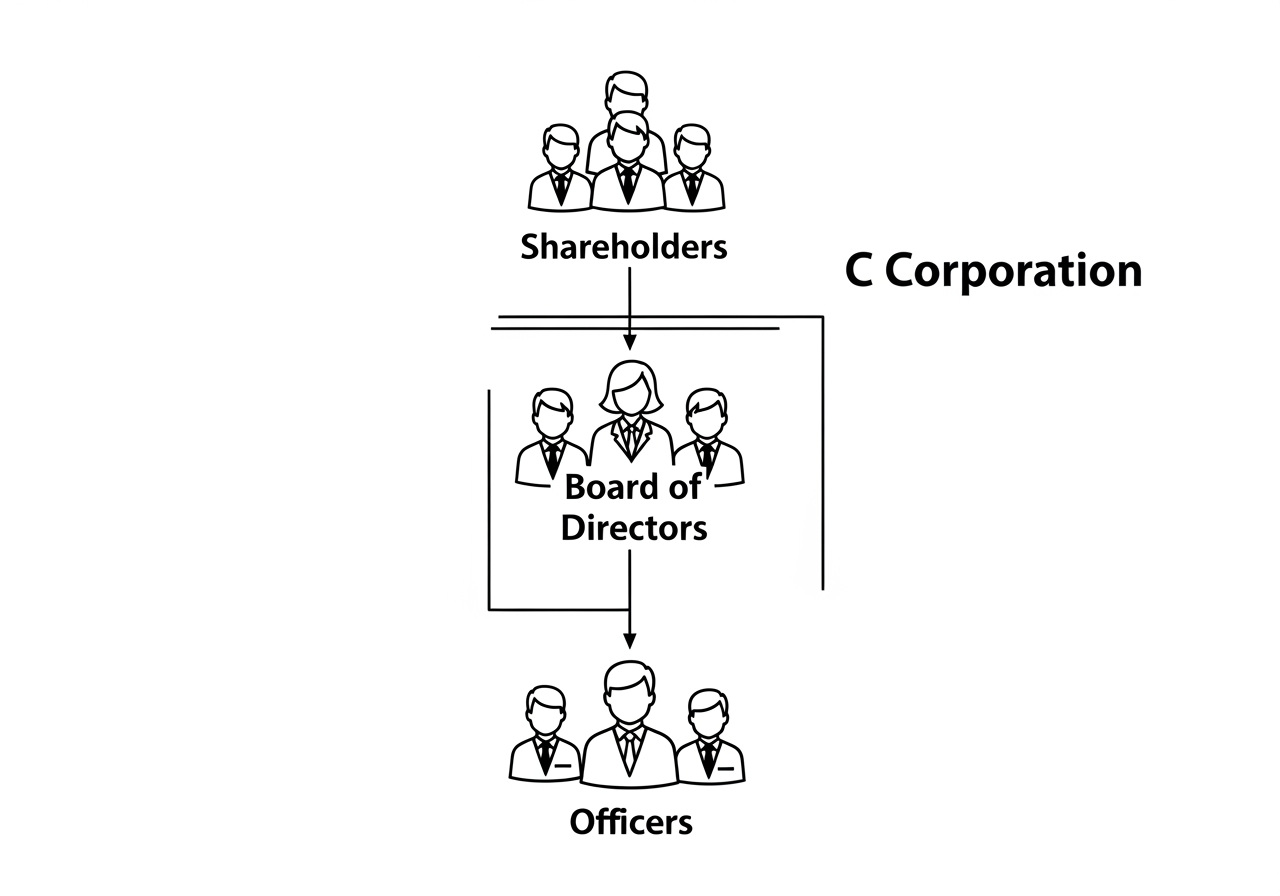
The structure of a C Corp typically involves shareholders (owners), a board of directors (oversees management), and officers (run day-to-day operations).
One of the most appealing features is limited liability protection, which shields the personal assets of shareholders, directors, and officers from the company's debts and legal issues. This protection requires adherence to corporate formalities. C Corps must follow strict state governance rules, including drafting bylaws, holding regular board and shareholder meetings, keeping detailed minutes, and maintaining corporate records. These tasks are crucial for maintaining the limited liability shield. Failure to do so can lead to "piercing the corporate veil," exposing owners to personal liability.
C Corp vs. Pass-Through Entities
Understanding a C Corp involves comparing it to pass-through entities like S Corporations (S Corps) and Limited Liability Companies (LLCs), where profits are passed directly to the owners' personal tax returns, avoiding corporate-level tax.
- S Corporation differences: An S Corp is a C Corp with a special tax election to avoid double taxation by passing profits and losses to shareholders. However, S Corps have ownership restrictions: a maximum of 100 U.S. citizen/resident shareholders and only one class of stock. This can hinder rapid growth and venture capital or international investment.
- LLC differences: An LLC combines corporate liability protection with the simplicity and tax flexibility of a partnership. By default, it's a pass-through entity, but it can elect to be taxed as a C or S Corp. LLCs have fewer formalities and ownership restrictions than C Corps, making them simpler to operate and appealing for many ventures.
The choice between these structures balances tax implications, liability, administrative burden, and growth goals. For businesses with high growth potential, diverse investor needs, and a desire for robust employee benefits, the C Corp tax advantages can outweigh the complexities.
Key C Corp Tax Advantages for Your Business
While double taxation is a concern, C Corps offer significant tax advantages that provide savings and flexibility for growing businesses. These benefits aid in corporate tax planning, foster business growth, attract investors, and allow for retaining earnings.

For a business in San Diego or anywhere in California with ambitious growth targets, understanding these benefits can be a game-changer. Let's explore the most compelling reasons a C Corp might be the right choice.
The 21% Flat Corporate Tax Rate
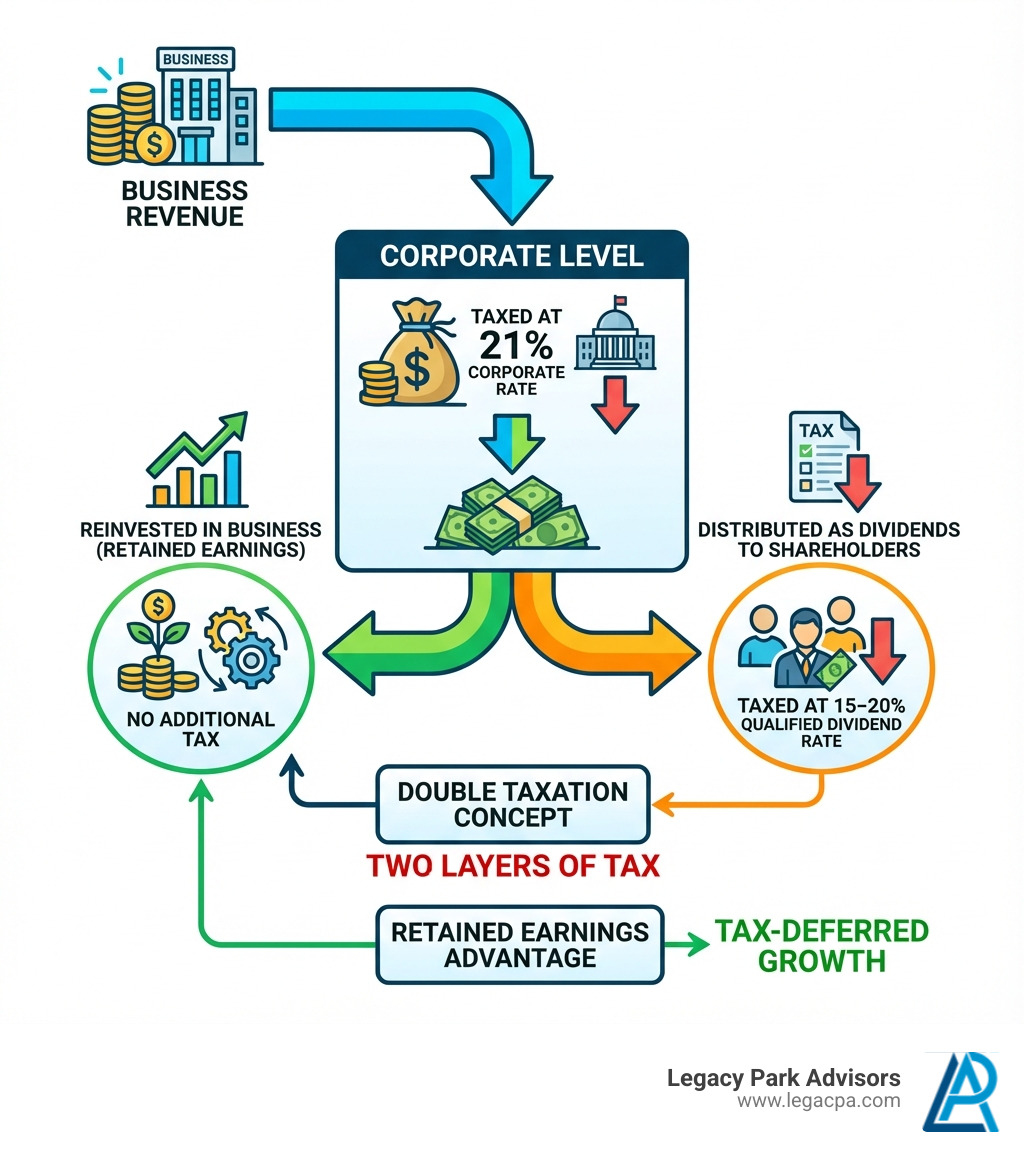
One of the most significant C Corp tax advantages is the flat 21% corporate tax rate established by the Tax Cuts and Jobs Act (TCJA) of 2017. This rate is often lower than top individual rates (up to 37%). For profitable businesses that don't distribute all profits, keeping them in the C Corp means they are taxed at this lower federal rate, unlike in pass-through entities where profits are taxed at the owner's individual rate.
This predictable tax liability simplifies financial planning and encourages reinvesting profits. With more capital available after taxes, businesses can accelerate growth by funding expansion, R&D, and hiring.
A Closer Look at C Corp Tax Advantages for Employee Benefits
C Corps also have an edge in handling employee benefits, a powerful tool for attracting top talent. The cost of many employee benefits is 100% deductible from the corporation's taxable income, reducing the company's tax bill and making benefits more affordable.
Key deductible benefits include:
- Deductible health insurance premiums: A C Corp can deduct the full cost of health insurance premiums for all employees, including owner-employees, who often face limitations in pass-through entities.
- Retirement plans (401k): Corporate contributions to employee retirement plans are fully tax-deductible.
- Fringe benefits: A wide array of other benefits like group term life insurance, disability insurance, and educational assistance can also be deductible.
By offering a comprehensive, tax-advantaged benefits package, C Corps can significantly boost their ability to attract top talent.
The Ultimate C Corp Tax Advantage: Qualified Small Business Stock (QSBS)
Perhaps the most compelling C Corp tax advantage is the Qualified Small Business Stock (QSBS) provision under Section 1202. It allows shareholders to potentially exclude all capital gains from federal tax when selling their stock. This provision was designed to incentivize investment in small businesses. If conditions are met, a shareholder can exclude up to 100% of capital gains, capped at $10 million or 10 times the stock's basis, whichever is greater.
To qualify as QSBS, the stock must meet several criteria:
- Issuance by a C Corporation: The stock must be originally issued by a domestic C corporation.
- Original Issue: The stock must be acquired directly from the corporation for money, property, or services.
- Active Business Requirement: At least 80% of the corporation's assets must be used in an active qualified trade or business. Certain service businesses are excluded.
- Gross Assets Test: The corporation's gross assets must not exceed $50 million when the stock is issued.
- Holding Period Requirement: The stock must be held for more than five years.
This capital gains exclusion is a massive investor incentive, making C Corps highly attractive for funding startups. Understanding the nuances of QSBS can be complex. For detailed information, consult the official IRS guidance on Qualified Small Business Stock. For a deeper dive into how this and other strategies can fit into your overall financial picture, explore More info about business tax planning on our site.
Understanding the Downsides: C Corp Disadvantages
While the C Corp tax advantages are compelling, it's crucial to understand the downsides. The primary concerns are double taxation, a higher administrative burden, and trapped losses.
Let's balance the scales and look at the considerations that might make a C Corp less suitable for your business.
The Challenge of Double Taxation
The most cited disadvantage of a C Corp is double taxation. This occurs because the corporation is a separate tax-paying entity. It works in two steps:
- Corporate level tax: The C Corp pays federal (and state, like California's 8.84%) income tax on its profits.
- Shareholder level tax on dividends: When the corporation distributes after-tax profits to shareholders as dividends, those shareholders pay individual income tax on them.
This contrasts with pass-through entities (S Corps, LLCs) where profits are taxed only once. However, savvy tax planning strategies can mitigate double taxation, including:
- Reasonable compensation: Paying owner-employees a reasonable salary is a corporate tax-deductible expense, so that profit is taxed only once at the individual level.
- Reinvesting earnings: Profits retained for growth are only taxed once at the corporate level.
- Employee benefits: Providing tax-deductible employee benefits is another way to distribute value without incurring double taxation.
- Timing of dividend distributions: Corporations can strategically time dividend distributions to years when shareholders are in lower tax brackets.
While double taxation is a legitimate concern, it can be managed with careful planning.
Increased Complexity and Formalities
Operating a C Corp involves more complexity and formalities than an LLC or sole proprietorship, leading to more administrative work and higher costs.
- State filing requirements: C Corps must adhere to strict state regulations, including annual reports.
- Annual meetings: C Corps are legally required to hold annual meetings for shareholders and directors.
- Meeting minutes: Detailed minutes of all significant corporate decisions must be kept.
- Separate bank accounts: Strict separation between corporate and personal finances is crucial.
- Higher administrative costs: These formalities often require professional help, leading to higher legal and accounting fees.
These burdensome requirements are essential for transparency, protecting the limited liability shield, and maintaining the corporation's good standing.
Is a C Corp Right for Your Business?
Deciding whether a C Corp is the optimal structure for your business involves weighing its unique tax advantages against its operational complexities. There's no one-size-fits-all answer; the best choice depends heavily on your business goals, growth projections, and investor strategy.
To help clarify, let's look at a comparison of the three primary business entities:
| Feature | C Corporation | S Corporation | Limited Liability Company (LLC) |
|---|---|---|---|
| Taxation | Corporate tax (21% flat) + Shareholder tax on dividends (double taxation) | Pass-through taxation (no corporate tax) | Pass-through taxation (default), can elect S/C Corp |
| Liability | Limited liability for owners | Limited liability for owners | Limited liability for owners |
| Ownership | Unlimited shareholders, multiple stock classes, international investors allowed | Max 100 shareholders, U.S. citizens/residents, one class of stock | Flexible, no limits, can be single-member |
| Formalities | High (board meetings, minutes, bylaws) | Moderate (some corporate formalities) | Low (operating agreement, few state-mandated meetings) |
| Growth Potential | High (attracts VC, public offerings) | Moderate (ownership limits restrict growth funding) | Moderate (can raise capital, but not ideal for public offerings) |
| Best for... | High-growth startups, venture capital, international investment, public companies | Small businesses, owner-operated, want pass-through but liability protection | Flexibility, liability protection, simpler operations, small to medium businesses |
Ideal Business Profile for a C Corp
Based on this comparison and our experience advising businesses in California, a C Corp typically shines for an ideal business profile that includes:
- Venture Capital Goals: If your business plans to seek significant outside investment from venture capitalists or angel investors, a C Corp is almost always the preferred structure. VCs and institutional investors favor C Corps because they can issue multiple classes of stock, allow for unlimited shareholders (including other corporations or international investors), and provide the QSBS capital gains exclusion incentive.
- International Investors: If you anticipate attracting investors from outside the United States, a C Corp is the only viable option among these three. S Corps and many LLC structures have restrictions on foreign ownership.
- Long-term Growth Strategy: Businesses with aggressive growth plans, aiming to go public, or looking to expand significantly will find the C Corp structure provides the necessary flexibility and tax advantages (like retained earnings and QSBS) to support these ambitions.
- Significant Reinvestment: If your business generates substantial profits that you intend to reinvest back into the company for expansion, rather than distributing them to owners, the 21% flat corporate tax rate can be highly advantageous.
- Extensive Employee Benefits: For companies wanting to offer comprehensive, tax-deductible employee benefits to attract and retain top talent, the C Corp structure is often superior.
The decision to form or convert to a C Corp should be part of a comprehensive long-term growth strategy. It's a strategic move often made when a business reaches a certain scale, has specific funding needs, or is ready for rapid expansion.
Frequently Asked Questions about C Corporations
Here, we address some of the most common inquiries we receive regarding C Corporations.
How can a C Corp mitigate double taxation?
While double taxation is a key feature of C Corps, smart tax planning can reduce its impact. Key strategies include:
- Reasonable salaries: Paying owner-employees a reasonable salary is a corporate tax-deductible expense. This shifts profit to be taxed once at the individual level.
- Reinvesting earnings: Retain profits for growth instead of distributing them as dividends. These earnings are taxed only once at the corporate rate, which is ideal for high-growth companies.
- Employee benefits: Provide tax-deductible benefits like health insurance and retirement plan contributions to deliver value without the second layer of tax.
- Loans to shareholders: Properly structured loans to shareholders can provide funds without being taxed as dividends, but they must be legitimate loans, not disguised distributions.
- Timing of dividend distributions: Strategically time dividend payments to years when shareholders are in lower tax brackets.
What is the current federal C Corp tax rate?
The federal C Corp tax rate is a flat 21%, established by the Tax Cuts and Jobs Act (TCJA) of 2017. This rate applies to all C Corps regardless of income. C Corporations are also subject to state corporate income taxes, which vary by state. For example, California's corporate tax rate is 8.84%.
Can an LLC choose to be taxed as a C Corp?
Yes. An LLC has the flexibility to choose its tax status by filing IRS Form 8832, "Entity Classification Election." While typically a pass-through entity, it can elect to be taxed as a C Corp.
There are several reasons for this election:
- Accessing C Corp tax advantages: To use the 21% flat tax rate, deduct employee benefits, or qualify for QSBS for its investors.
- Attracting venture capital: Many VCs prefer to invest in C Corps, so an LLC may elect this status to attract funding.
- Simplified ownership for certain investors: C Corp status simplifies tax implications for corporate or international investors.
This flexibility allows businesses to adapt their tax strategy as they grow without a full legal conversion.
Conclusion: Secure Your Financial Legacy with Strategic Tax Planning
Choosing the right business entity is a foundational decision that impacts your company's tax burden, operational flexibility, and long-term growth potential. As we've explored, C Corp tax advantages can be substantial, offering a flat 21% corporate tax rate, full deductibility for employee benefits, and the powerful QSBS capital gains exclusion. These benefits are particularly attractive for businesses with high growth aspirations, plans to attract venture capital or international investors, and a desire to reinvest profits strategically.
However, it's equally important to acknowledge the C Corp's downsides, primarily the challenge of double taxation and the increased administrative burden and compliance costs. While these are real considerations, they can often be mitigated through proactive and sophisticated tax planning strategies.
There's no single "best" entity for every business. What works for a small, owner-operated service business might not be suitable for a rapidly scaling tech startup in San Diego. The optimal choice depends on your unique circumstances, current business stage, future goals, and appetite for administrative complexity.
At Legacy Park Advisors, we understand that securing and growing your financial legacy requires more than just filing taxes – it demands proactive, custom tax planning strategies. We believe in a collaborative, client-centric approach to help individuals, families, and businesses like yours steer these complex decisions.
Don't let the intricacies of corporate structures deter you from making the most strategic choice for your business. We're here to help you understand the nuances, weigh the pros and cons, and develop a tax plan that aligns with your vision.
Ready to explore how a C Corp, or another entity structure, might best serve your business's future? Contact us for strategic business tax planning today, and let's work together to secure your financial legacy.
___
The information contained in this blog is provided for general informational purposes only and does not constitute accounting, tax, legal, or investment advice. The content is not intended to be a substitute for professional advice tailored to your specific circumstances.