


Understanding Capital Gains Tax: A Quick Overview
Capital gains tax is one of the most important taxes you'll face when selling investments, property, or other valuable assets. If you've made a profit from the sale of stocks, real estate, artwork, or even cryptocurrency, the Internal Revenue Service (IRS) and your state tax authority want a share of those gains.
Here's what you need to know right now:
- Capital gains are the profits you make when you sell an asset for more than you paid for it (your "cost basis").
- In the U.S., gains are classified as short-term (held one year or less) or long-term (held more than one year).
- Short-term gains are taxed at your ordinary income tax rate.
- Long-term gains are taxed at lower federal rates: 0%, 15%, or 20%, depending on your income.
- State taxes also apply. California, for instance, taxes all capital gains as regular income.
- You only pay tax when you sell the asset (this is called "realizing" the gain).
- Capital losses can offset your gains, reducing your tax bill.
- Your primary residence may qualify for a large tax exclusion on the gain from its sale.
Think of it this way: if you bought shares for $10,000 and sold them for $15,000 after holding them for two years, you have a $5,000 long-term capital gain. Depending on your income, the federal tax on that gain could be $0, $750 (15%), or $1,000 (20%), plus any applicable state taxes.
The good news? There are legitimate strategies to minimize your capital gains tax. From using tax-advantaged accounts like 401(k)s and IRAs to timing your asset sales strategically, smart planning can keep more money in your pocket.
Whether you're selling stocks, a rental property, or a business, understanding how capital gains tax works is crucial for protecting your wealth. In this guide, we'll walk you through everything you need to know—from basic calculations to advanced strategies that can significantly reduce your tax burden.
What Are Capital Gains?
At its core, a capital gain is simply the profit you make when you sell a "capital asset" for more than you originally paid for it. Conversely, a capital loss occurs when you sell an asset for less than its original purchase price. These assets can be almost anything you own for personal use or investment purposes.
Let's break down what we mean by "capital asset":
- Investments: This is often the first thing that comes to mind. Stocks, bonds, mutual funds, and exchange-traded funds (ETFs) all fall into this category. Newer digital assets like cryptocurrency are also treated as capital assets by the IRS. If you buy a stock for $50 and sell it for $75, that $25 profit per share is a capital gain.
- Real Estate: Beyond your primary home (which has its own special exclusion), properties like vacation homes, rental units, or undeveloped land are capital assets. Selling a rental property for a profit will trigger capital gains tax.
- Personal-Use Property: This can include things like artwork, jewelry, collectibles, and boats. If you sell these items for a profit, the gain is generally taxable. However, if you sell them for a loss, that loss is typically not deductible.
- Business Property: Assets used in a business, such as land, buildings, or equipment, can also generate capital gains or losses when sold.
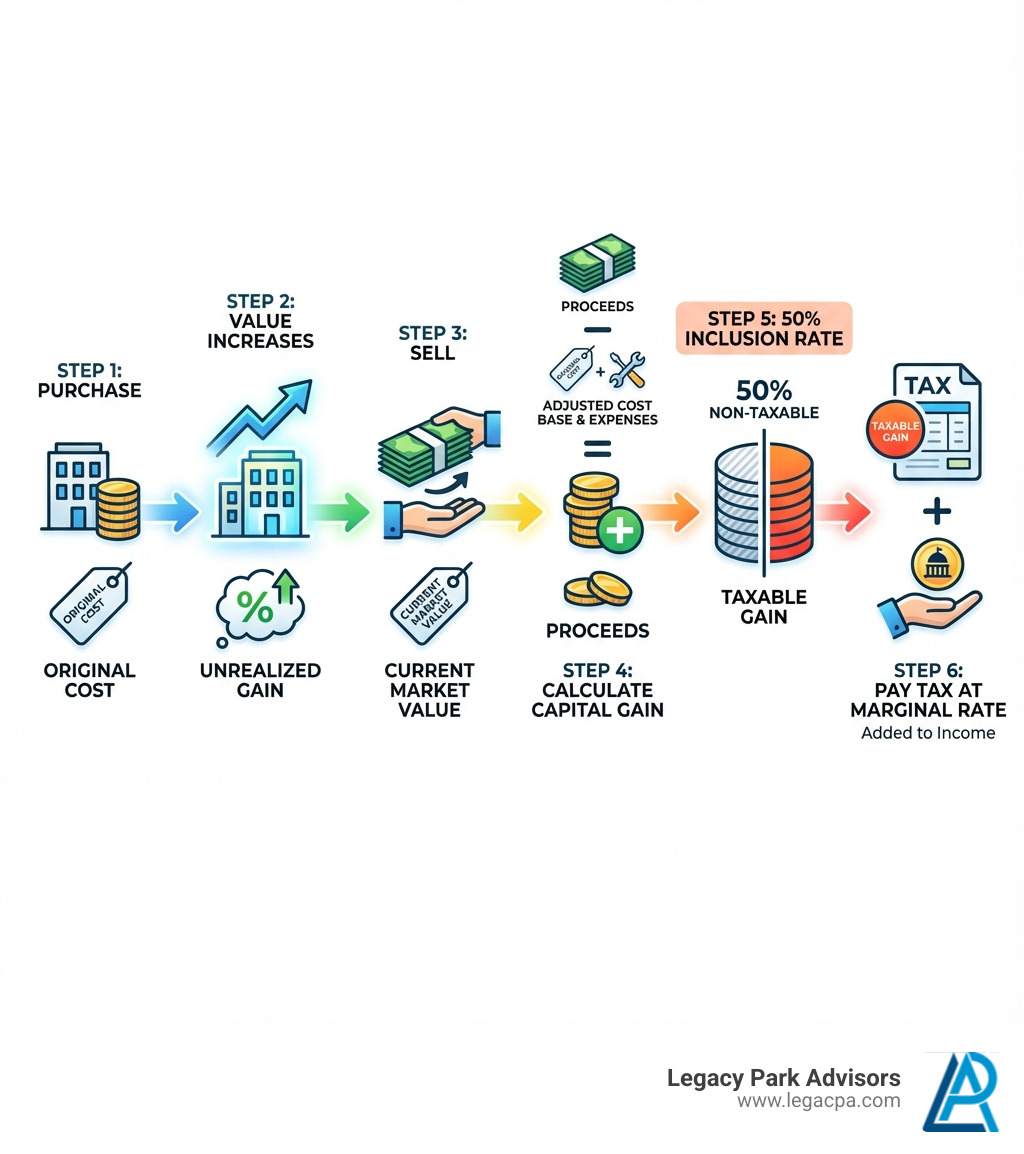
It's important to differentiate between "realized" and "unrealized" gains. An unrealized gain is the increase in value of an asset you still own. You don't pay capital gains tax on this paper profit. The tax only becomes due when you "realize" the gain by actually selling the asset. This is why some investors might feel "locked in" to an investment, reluctant to sell and trigger a tax bill.
How Capital Gains Tax is Calculated
Calculating your capital gains tax isn't as daunting as it might seem, but it does require a few key figures. The goal is to determine your actual profit, and then figure out how that profit will be taxed based on the holding period.
Here's the basic formula:
Capital Gain (or Loss) = Proceeds from Sale - (Adjusted Basis + Selling Expenses)
Let's unpack each component:
- Proceeds from Sale: This is the total amount you receive when you sell your capital property. If you sell shares for $10,000, that's your proceeds.
- Selling Expenses: These are the costs you incur specifically to sell the property. Think of them as the transaction fees that eat into your profit. For stocks, this might be brokerage commissions. For real estate, it could include legal fees, real estate agent commissions, or appraisal fees. These expenses increase your basis or reduce your sale proceeds, which lowers your capital gain.
- Adjusted Basis: This is arguably the most crucial part of the equation. It represents what it truly cost you to acquire and improve the asset. We'll dive deeper into this next.
Once you have your capital gain, you must determine if it's short-term or long-term. This dictates the tax rate you'll pay. For official details, we always recommend you check the IRS website on capital gains and losses.
Understanding Your Adjusted Basis
Your Adjusted Basis is the starting point for determining your profit. It's not just the sticker price; it's the original cost of the property plus any expenses you incurred to acquire it, and the cost of any capital improvements you've made. Think of it as the grand total of what you've invested in the asset.
Here’s what typically goes into your adjusted basis:
- Original purchase price: The amount you paid for the asset.
- Acquisition costs: These are costs directly related to buying the asset. For investments, this might be brokerage commissions. For real estate, it could include certain legal fees, recording fees, or other closing costs.
- Capital improvements vs. repairs: This distinction is vital, especially for real estate.
- Capital improvements are costs that add to the value of your property, prolong its useful life, or adapt it to new uses. These are added to your basis. Examples include adding a new room, replacing a roof, or a major kitchen remodel.
- Repairs and maintenance are routine costs that keep your property in good operating condition but don't materially add to its value or prolong its life. Examples include painting, fixing leaks, or property taxes. These are not added to your basis, though they may be deductible as rental expenses if it's an investment property.
Calculating your basis accurately is crucial because a higher basis means a lower capital gain, and therefore, a lower capital gains tax bill. Keeping meticulous records of all purchase documents, transaction slips, and receipts for major improvements is essential.
Short-Term vs. Long-Term Capital Gains Rates
In the U.S., we don't have a single capital gains tax rate. The rate you pay depends primarily on how long you held the asset.
- Short-Term Capital Gains: If you hold an asset for one year or less before selling, your profit is considered a short-term gain. It is added to your other income and taxed at your regular marginal income tax rate, which can be as high as 37% at the federal level.
- Long-Term Capital Gains: If you hold an asset for more than one year, your profit is a long-term gain and qualifies for preferential federal tax rates. For 2024, these rates are:
- 0% for individuals with taxable income up to $47,025 (or $94,050 for married couples).
- 15% for individuals with taxable income between $47,026 and $518,900 (or $94,051 to $583,750 for married couples).
- 20% for individuals with taxable income above $518,900 (or $583,750 for married couples).
Don't forget about state taxes! Here in California, there is no special rate for long-term capital gains. All gains are taxed as ordinary income at rates up to 13.3%. Furthermore, high-income earners may also be subject to the 3.8% Net Investment Income Tax (NIIT) on top of their regular capital gains tax, further increasing the total tax bite.
Key Strategies to Minimize Your Taxable Gains
Nobody enjoys paying more tax than necessary, and when it comes to capital gains tax, there are several perfectly legitimate and smart strategies we can employ to keep more of your hard-earned profits in your pocket. Proactive tax planning is not just about compliance; it's about optimizing your financial future.
Effective tax planning often involves:
- Timing of asset sales: Sometimes, simply holding an asset for a few more days to qualify for long-term treatment can cut your federal tax rate in half.
- Utilizing available exemptions and tax-advantaged accounts: The tax system offers various breaks designed to encourage saving and investing. We want to make sure you're taking full advantage of them.
Let's explore some of these key strategies.
Leveraging Capital Losses to Offset Gains
If you've ever sold an investment for less than you paid for it, you've experienced a capital loss. While nobody likes losing money, this practice, known as tax-loss harvesting, can be a powerful tool to reduce your capital gains tax bill.
Here's how we leverage losses:
- Offsetting gains in the current year: The most straightforward use of a capital loss is to offset any capital gains you've realized in the same tax year. This reduces your net taxable gain.
- Deducting against ordinary income: If your capital losses exceed your capital gains, you can deduct up to $3,000 of the excess loss against your ordinary income (like your salary) each year.
- Carry-forward rule (indefinite): If you have more than $3,000 in net capital losses, you can carry the remainder forward indefinitely. These losses can be used to reduce capital gains or offset ordinary income in future years.
- The "wash-sale" rule: The IRS is savvy to attempts to create artificial losses. The "wash-sale" rule prevents you from claiming a capital loss if you sell a security and then buy back the same or a "substantially identical" one within 30 days before or after the sale. This 61-day window is designed to stop investors from selling an asset just to claim a loss, only to immediately repurchase it. You can learn more in IRS Publication 550.
Keeping track of your capital losses is just as important as tracking your gains. We can help you manage these to ensure you're minimizing your tax liability effectively.
Utilizing Tax-Advantaged Accounts
One of the best strategies to reduce or even eliminate capital gains tax is to hold your investments within tax-advantaged accounts. These accounts offer significant benefits that can boost your long-term wealth accumulation.
Here's a list of common tax-advantaged accounts in the U.S. and how they help with capital gains:
- Traditional 401(k)s and IRAs: Investments within these accounts grow on a tax-deferred basis. You don't pay capital gains tax (or any other investment income tax) on transactions within the account. Taxes are only paid when you withdraw the funds, typically in retirement.
- Roth 401(k)s and IRAs: These are even more powerful for tax-free growth. While contributions are made with after-tax dollars, your investments grow completely tax-free. All qualified withdrawals, including decades of capital gains, are 100% free from federal tax.
- Health Savings Accounts (HSAs): Often called a "triple tax-advantaged" account, HSAs allow for tax-deductible contributions, tax-free investment growth (including capital gains), and tax-free withdrawals for qualified medical expenses. It's an excellent tool for both healthcare and retirement savings.
By strategically using these accounts, you can shield a substantial portion of your investment growth from capital gains tax, allowing your wealth to compound more effectively.
Donating Assets and Gifting Property
Generosity can also be tax-smart! There are specific rules that allow you to donate or gift assets in a way that minimizes or even eliminates capital gains tax.
- Donating appreciated securities: This is a particularly powerful strategy. If you donate publicly traded securities that you've held for more than a year directly to a qualified charity, you can generally deduct the full fair market value of the asset. Better yet, you avoid paying any capital gains tax on the appreciation. It's a win-win: you support a cause you care about and get a double tax benefit.
- Gifting property: When you gift an asset to someone, you generally don't trigger a capital gain. The recipient of the gift takes on your original cost basis (a "carryover basis"). They will be responsible for the capital gains tax when they eventually sell the asset. This can be a useful estate planning tool, especially when gifting to someone in a lower tax bracket. Gifting to a U.S. citizen spouse is generally unlimited and tax-free.
Exemptions and Special Considerations
While capital gains tax is broad, the U.S. tax system offers some notable exemptions and special considerations that can significantly impact your tax liability. Understanding these can save you a fortune.

The Primary Residence Exclusion
For many Americans, their home is their biggest asset, and fortunately, it comes with a fantastic tax break: the primary residence exclusion (also known as the Section 121 exclusion). This rule allows you to sell your main home and exclude a large portion of the profit from capital gains tax.
Here's what you need to know:
- Exclusion amounts: You can exclude up to $250,000 of the gain if you're a single filer, or up to $500,000 if you're married and file a joint return.
- Ownership and use tests: To qualify, you must have owned and used the property as your primary residence for at least two of the five years leading up to the sale. The two years do not have to be consecutive.
- Frequency limit: You can generally only claim this exclusion once every two years.
- Reporting the sale: If your entire gain is excludable, you may not even have to report the sale on your tax return. However, if you receive a Form 1099-S or if part of your gain is taxable, you must report it. For full details, see IRS Publication 523, Selling Your Home.
The primary residence exclusion is a cornerstone of tax planning for homeowners in the U.S.
How Estate Planning Relates to Capital Gains Tax
Estate planning isn't just about who gets what; it's also about managing the tax implications of your assets after you're gone. When it comes to capital gains tax, the U.S. has a rule that is incredibly beneficial for your heirs.
- Step-up in basis at death: When you pass away, the cost basis of most capital assets in your estate is "stepped up" to its fair market value on the date of your death. This means all the unrealized capital gains that accumulated during your lifetime are completely and permanently erased for income tax purposes.
- No tax bill for your heirs: Because of the step-up in basis, if your beneficiaries sell the inherited assets shortly after your death, there will be little to no capital gains tax to pay. This is a massive advantage compared to the tax systems in many other countries.
- Importance of having a will or trust: This is where a well-crafted estate plan becomes invaluable. It ensures your assets are distributed according to your wishes and allows for the seamless transfer of property. Shockingly, a 2024 survey from Caring.com found that 68% of Americans do not have a will, leaving their estates vulnerable to probate court and potential family disputes.
- Using life insurance for liquidity: For very large estates that may be subject to federal estate tax, a life insurance policy can provide a tax-free payout to your beneficiaries. This cash can be used to cover estate taxes or other expenses, ensuring that your primary assets (like a family business or real estate) don't need to be sold to pay a tax bill.
Frequently Asked Questions about Capital Gains Tax
We often get asked similar questions about capital gains tax, so let's tackle some of the most common ones to clarify any lingering doubts.
What assets are subject to capital gains tax?
Almost any asset you own for personal use or investment purposes can be subject to capital gains tax when you sell it for a profit. This includes:
- Stocks, Bonds, Mutual Funds, and ETFs: These are the classic investment vehicles. If you buy low and sell high, the profit is a capital gain.
- Real Estate: This refers to properties other than your primary residence, such as vacation homes, rental properties, or commercial real estate.
- Cryptocurrency: The IRS treats digital assets like Bitcoin or Ethereum as property, meaning any profit from selling or exchanging them is a capital gain.
- Collectibles: Items like artwork, jewelry, rare coins, and stamps are capital assets. Long-term gains on collectibles are taxed at a maximum federal rate of 28%.
Essentially, if you sell something for more than its basis (and it's not covered by an exclusion or held in a tax-advantaged account), you're likely looking at a capital gain.
Is there a standard capital gains tax rate?
No, there isn't a single, standard capital gains tax rate in the U.S. This is a common misconception!
Instead, the tax rate on your gain depends on several factors:
- The holding period: Gains on assets held for one year or less (short-term) are taxed at your ordinary income rate. Gains on assets held for more than one year (long-term) are taxed at lower federal rates.
- Your taxable income: Your income level determines which long-term rate applies (0%, 15%, or 20%).
- The type of asset: As noted, long-term gains on collectibles are taxed at a special 28% rate.
- Your state of residence: States have their own rules. A resident of a no-income-tax state like Texas or Florida will have a very different result than a resident of California, where gains are taxed as ordinary income.
Can I use capital losses from previous years?
Absolutely! This is one of the most valuable tools for managing your capital gains tax.
- Net capital losses can be carried forward indefinitely: If you have a net capital loss for the year (your losses exceed your gains), you can carry the unused portion forward to future tax years. There is no expiration date.
- Offset future gains and income: In any future year, you can use these carried-over losses to offset capital gains. If you still have losses remaining, you can use up to $3,000 per year to offset ordinary income. This process repeats until the carried-over losses are fully used up. For more information, you can consult IRS Publication 550, Investment Income and Expenses.
Secure Your Financial Legacy
Navigating capital gains tax can feel complex, but with the right knowledge and strategic planning, it's entirely manageable. We’ve covered a lot of ground, from understanding what constitutes a capital gain to calculating your tax liability and exploring various U.S.-specific strategies to minimize it.
The key takeaway is this: proactive tax planning is crucial. By understanding concepts like adjusted basis, distinguishing between long-term and short-term gains, leveraging capital losses, utilizing tax-advantaged accounts like IRAs and 401(k)s, and taking advantage of the primary residence exclusion, you can significantly reduce your tax burden. Minimizing your tax outflow means maximizing your returns and preserving more of your wealth for yourself and your loved ones.
At Legacy Park Advisors, we believe in a collaborative, client-centric approach, focusing on securing and growing financial legacies. Don’t let the complexities of capital gains tax deter you from making smart financial decisions.
More info about our tax planning services
The information contained in this blog is provided for general informational purposes only and does not constitute accounting, tax, legal, or investment advice. The content is not intended to be a substitute for professional advice tailored to your specific circumstances.