


Why Tax-Efficient Investing Should Be Part of Your Wealth Strategy
Tax-efficient investing is the practice of structuring your investment portfolio to legally minimize the taxes you pay on returns, allowing you to keep more of what you earn and accelerate wealth growth over time.
Key Components of Tax-Efficient Investing:
- Account Selection - Using the right mix of taxable, tax-deferred, and tax-exempt accounts
- Asset Location - Placing tax-inefficient investments (bonds, REITs) in tax-advantaged accounts and tax-efficient investments (index funds, growth stocks) in taxable accounts
- Investment Selection - Choosing low-turnover funds, ETFs, municipal bonds, and other tax-efficient vehicles
- Strategic Timing - Holding investments long enough to qualify for lower long-term capital gains rates (0%, 15%, or 20% vs. ordinary income rates up to 37%)
- Tax-Loss Harvesting - Offsetting gains by selling losing positions while avoiding wash-sale rules
Tax-efficient investing is not tax avoidance. It's a legal, proactive strategy that uses provisions in the tax code to your advantage.
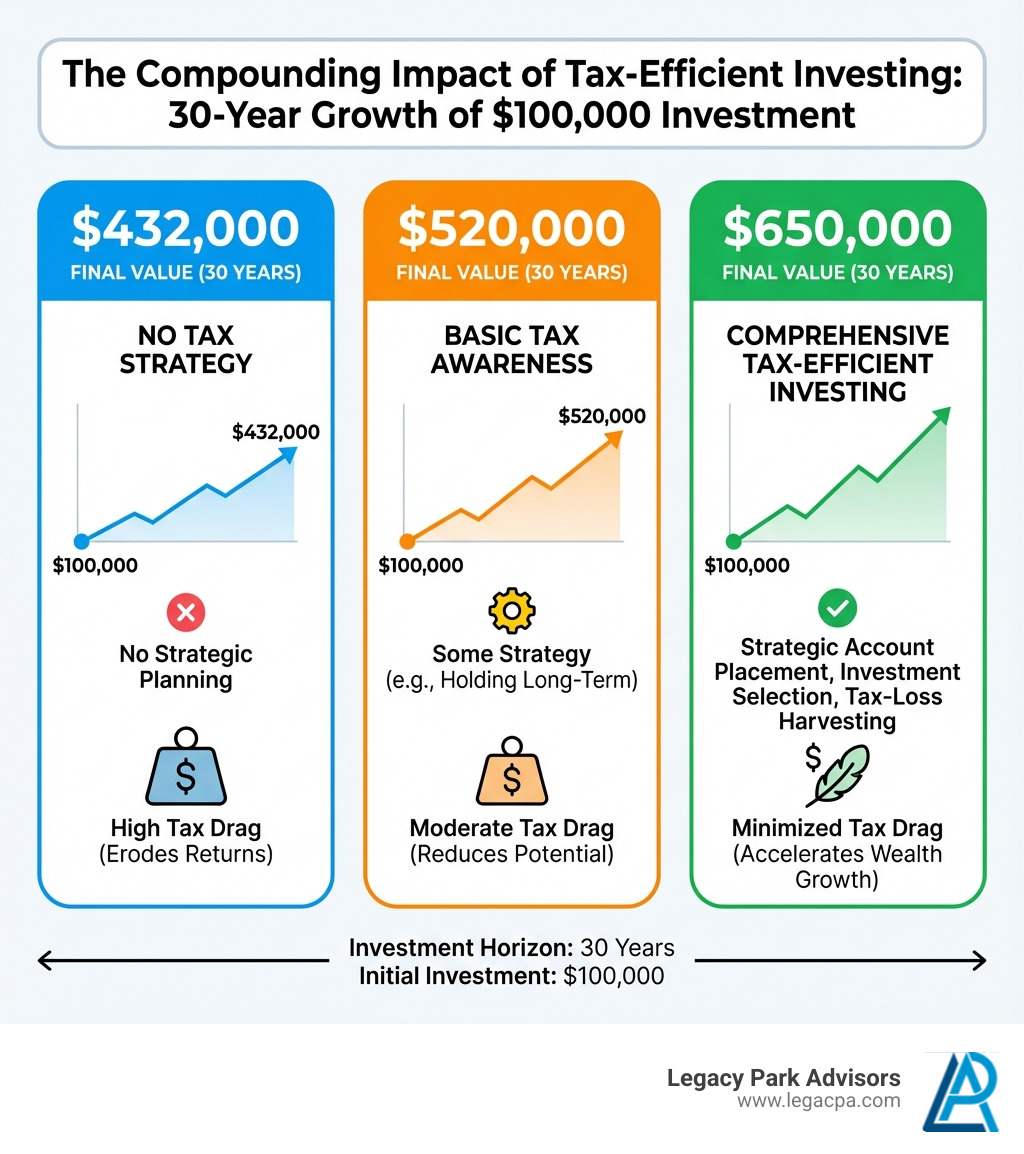
Here's why it matters: of all the expenses an investor pays, taxes have the potential to take the biggest bite out of total returns. Research shows that the difference between optimal and suboptimal asset location can exceed $160,000 over just ten years on a balanced portfolio. Over decades, that gap compounds dramatically.
The earlier you start implementing these strategies, the greater your long-term benefit. Markets may be loud and unpredictable, but taxes are quiet and persistent—making smart tax decisions today can fundamentally change your financial trajectory.
The Three Buckets: Understanding Your Investment Accounts

To master tax-efficient investing, you must understand the different types of investment accounts and how they are taxed. Think of them as buckets, each with rules for contributions, growth, and withdrawals. Using these buckets strategically is foundational to minimizing your tax burden and maximizing after-tax returns.
Taxable Accounts (Brokerage)
Standard brokerage accounts offer the most flexibility but the least tax protection. Income generated—interest, dividends, or capital gains—is generally taxed in the year it's realized.
- Interest Income: Taxed as ordinary income at your marginal tax rate.
- Dividends: Can be taxed as ordinary income or at lower qualified dividend rates, depending on the type of dividend and your holding period.
- Capital Gains: When you sell an investment for a profit, you realize a capital gain.
- Short-term capital gains (for assets held one year or less) are taxed as ordinary income at your marginal rate. For example, for tax year 2025, ordinary income tax rates can range from 10% to 37% for single filers.
- Long-term capital gains (for assets held over one year) are taxed at more favorable rates: 0%, 15%, or 20%, depending on your taxable income and filing status. This distinction highlights the importance of holding periods in tax-efficient investing.
While taxable accounts expose you to annual taxes, they also offer the best liquidity and no restrictions on when or how much you can withdraw (other than normal trade settlement periods). They also allow for strategies like tax-loss harvesting, which we'll discuss later.
Tax-Deferred Accounts (Traditional 401(k)s & IRAs)
A cornerstone of retirement planning and tax-efficient investing, these accounts are funded with pre-tax dollars, reducing your current taxable income. Investments grow tax-deferred, so you don't pay taxes on gains until withdrawal in retirement.
- Contributions: Often tax-deductible, reducing your current taxable income.
- Growth: All earnings and capital appreciation grow tax-deferred. You won't see a tax bill year after year for dividends or capital gains within these accounts.
- Withdrawals: When you take money out in retirement, all withdrawals (contributions and earnings) are taxed as ordinary income. Required Minimum Distributions (RMDs) usually begin at age 73 (for 2025), compelling you to start withdrawing funds whether you need them or not.
Tax-deferred accounts are particularly powerful if you expect to be in a lower tax bracket in retirement than you are during your working years. They provide significant immediate tax savings and allow your investments to compound faster without annual tax drag.
Tax-Exempt Accounts (Roth 401(k)s & IRAs, HSAs)
These accounts are a top choice for tax-efficient investing, especially for those who anticipate higher tax rates in the future.
- Contributions: Made with after-tax dollars, meaning they do not provide an upfront tax deduction.
- Growth: All earnings and capital appreciation grow entirely tax-free.
- Qualified Withdrawals: If you meet certain conditions (typically age 59½ and the account has been open for at least five years), all withdrawals are completely tax-free, including both your contributions and all the growth. Roth IRAs also have the added benefit of no RMDs for the original owner, offering incredible flexibility for legacy planning.
Health Savings Accounts (HSAs) are another powerful tax-exempt account. Eligible individuals get a triple tax advantage: tax-deductible contributions (or pre-tax through payroll), tax-free growth, and tax-free withdrawals for qualified medical expenses. This makes them an exceptional tool for long-term savings, particularly for healthcare costs in retirement.
TABLE comparing Taxable, Tax-Deferred, and Tax-Exempt Accounts
| Feature | Taxable Accounts (Brokerage) | Tax-Deferred Accounts (Traditional 401(k)/IRA) | Tax-Exempt Accounts (Roth 401(k)/IRA, HSA) |
|---|---|---|---|
| Contributions | After-tax | Pre-tax (usually tax-deductible) | After-tax (no upfront deduction) |
| Growth | Taxed annually | Tax-deferred | Tax-free |
| Withdrawals | No restrictions, potential capital gains tax | Taxed as ordinary income in retirement | Tax-free (if qualified) |
| RMDs | None | Yes (typically age 73 for 2025) | No (for original Roth IRA owner) |
| Flexibility | High | Moderate (penalties for early withdrawals) | Moderate (penalties for early withdrawals) |
Core Strategies for Tax Efficient Investing

Understanding the different account types is just the beginning. The real art of tax-efficient investing lies in strategically deploying your assets across these accounts and making smart decisions about what to buy, when to sell, and how to manage your portfolio over time. Think of it as a game of chess, where every move has tax implications.
Asset Location: Putting Investments in the Right Place
Asset location is arguably one of the most impactful strategies in tax-efficient investing. It's the practice of placing specific types of investments in the account types where they will be taxed most favorably. This isn't about what you own (that's asset allocation), but where you own it.
The general rule is to place tax-inefficient assets in tax-advantaged accounts (tax-deferred or tax-exempt) and tax-efficient assets in taxable accounts.
- Tax-Inefficient Assets in Tax-Advantaged Accounts: Investments that generate a lot of taxable income, such as highly active funds, Real Estate Investment Trusts (REITs), or high-yield taxable bonds, are best placed in tax-deferred accounts (like a Traditional IRA or 401(k)). This shelters their annual income from immediate taxation, allowing them to compound more effectively. For example, interest income from corporate bonds is taxed at both federal and state levels in California, making them a prime candidate for tax-deferred accounts.
- Tax-Efficient Assets in Taxable Accounts: Investments that are inherently more tax-friendly, such as broad-market index funds or ETFs with low turnover, or individual growth stocks you plan to hold long-term, are often well-suited for taxable brokerage accounts. These investments tend to generate fewer capital gains distributions and allow you to benefit from lower long-term capital gains tax rates when you eventually sell. Growth stocks placed in a Roth IRA can also be incredibly powerful, as their appreciation grows and can be withdrawn completely tax-free.
Research from Vanguard highlights the significant impact of asset location. In one scenario, a portfolio with index equity in a taxable account and taxable bonds in a tax-deferred account resulted in a portfolio balance more than $160,000 higher after just ten years compared to the reverse placement. This demonstrates that strategic asset location is a powerful driver of after-tax wealth.
Research on asset location best practices
Investment Selection: Choosing the Right Vehicles
Beyond where you place your assets, what you invest in also plays a crucial role in tax-efficient investing. Some investment vehicles are simply designed to be more tax-friendly than others.
- Broad Market Index Funds and ETFs: These are often considered champions of tax-efficient investing for taxable accounts. They typically have low turnover, which minimizes capital gains distributions. ETFs, in particular, have a unique structural advantage that further reduces the likelihood of distributing capital gains. Historically, the tax cost for index equity funds has been about 100 basis points (bps), significantly lower than the 200 bps for active equity funds.
- Municipal Bonds: For investors in higher tax brackets, municipal bonds can be a fantastic tool. The interest income from municipal bonds is generally exempt from federal income tax. For California residents, if you invest in municipal bonds issued within California, that interest income is also exempt from California state income tax, offering a powerful double tax exemption.
- Treasury Bonds: Interest from U.S. Treasury bonds is exempt from state and local income taxes. While it's still subject to federal income tax, for California residents, this exemption from state tax can be a meaningful benefit.
- Low-Turnover Funds: Whether index funds or actively managed funds, those with lower portfolio turnover will generally generate fewer taxable events, making them more tax-efficient.
Examples of tax-efficient investment options
Timing Your Transactions: The Importance of Holding Periods
The calendar can be your friend or foe in tax-efficient investing. The length of time you hold an investment before selling it directly impacts how your capital gains are taxed.
- Short-Term vs. Long-Term Capital Gains:
- Short-term capital gains arise from selling investments held for one year or less. These gains are taxed at your ordinary income tax rate, which can be as high as 37% at the federal level.
- Long-term capital gains come from selling investments held for more than one year. These are taxed at preferential federal rates of 0%, 15%, or 20%, depending on your taxable income. For tax year 2025, for example, a single filer with taxable income up to $48,350 would pay 0% on long-term capital gains. This significant difference makes holding investments for over a year a key tenet of tax-efficient investing.
- Qualified vs. Ordinary Dividends: The tax treatment of dividends also depends on holding periods.
- Qualified dividends are taxed at the same favorable long-term capital gains rates (0%, 15%, or 20%). To qualify, you generally need to hold the stock for more than 60 days during the 121-day period that begins 60 days before the ex-dividend date.
- Ordinary (non-qualified) dividends are taxed at your higher ordinary income tax rate.
Being mindful of these holding periods can save you a substantial amount in taxes. Waiting just a few extra weeks to turn a short-term gain into a long-term gain can dramatically reduce your tax bill.
Guide to understanding qualified dividends
Advanced Tax-Saving Tactics
Once you've mastered the basics of account types, asset location, and investment selection, you can open up even more powerful strategies to boost your tax-efficient investing. These tactics often involve actively managing your portfolio throughout the year, not just at tax time.
Tax-Loss Harvesting: Turning Losses into Opportunities
Even the most successful investors experience losses. The silver lining? You can turn those losses into a tax advantage through a strategy called tax-loss harvesting. This involves selling investments that have declined in value to "harvest" the capital loss.
Here's how it works:
- Offsetting Gains: Realized capital losses can be used to offset any capital gains you've realized from selling other profitable investments during the year. This reduces your overall taxable gains.
- Offsetting Ordinary Income: If your capital losses exceed your capital gains, you can use up to $3,000 of those excess losses to reduce your ordinary taxable income each year.
- Carryforward: Any remaining capital losses beyond the $3,000 deduction can be carried forward indefinitely to offset future capital gains or ordinary income.
The Wash-Sale Rule: A Crucial Caveat The IRS, in its wisdom, doesn't want you to simply sell a stock at a loss, claim the deduction, and then immediately buy it back. This is where the "wash-sale rule" comes in. If you sell a security at a loss and then buy a "substantially identical" security within 30 days before or after the sale date (a 61-day window), the loss is disallowed. To avoid a wash sale, you must either wait at least 31 days to repurchase the same security or buy a different, but correlated, security (e.g., selling an S&P 500 ETF and buying a total stock market ETF). This allows you to maintain market exposure while still claiming the loss.
Tax-loss harvesting requires careful planning and attention to detail, but it can be a significant boost to your tax-efficient investing efforts, especially in volatile markets.
Tax-Smart Charitable Giving
Giving back is a noble endeavor, and with smart planning, it can also be incredibly tax-efficient. For those of us in San Diego and across California, leveraging charitable giving strategies can reduce both federal and state tax liabilities.
- Donating Appreciated Stock: Instead of selling appreciated stock (which triggers capital gains tax) and then donating the cash, you can donate the stock directly to a qualified charity. By doing so, you avoid paying capital gains tax on the appreciation, and you can typically deduct the fair market value of the stock (up to certain limits) from your taxable income. This is a win-win for you and the charity.
- Qualified Charitable Distributions (QCDs): If you're 70½ or older and have a Traditional IRA, you can make a QCD directly from your IRA to a qualified charity. This distribution counts towards your Required Minimum Distribution (RMD) but isn't included in your adjusted gross income (AGI). This can be particularly beneficial for managing your income and potentially avoiding higher Medicare premiums (IRMAA).
- Donor-Advised Funds (DAFs): These funds allow you to make a charitable contribution, receive an immediate tax deduction, and then recommend grants to charities over time. DAFs are excellent for "bunching" charitable deductions.
- Bunching Deductions: With the higher standard deduction (for 2025, it's $15,000 for single filers and $30,000 for married filing jointly), many taxpayers no longer itemize annually. Bunching involves consolidating several years' worth of charitable contributions into a single year, allowing you to exceed the standard deduction threshold and itemize in that year, then take the standard deduction in subsequent years.
Integrating Tax Efficiency into Your Financial Life
Tax-efficient investing isn't a one-time adjustment; it's an ongoing process that touches every aspect of your financial life, especially as you approach and enter retirement. It also involves balancing tax considerations with your overall financial goals and risk tolerance.
Tax-Efficient Withdrawal Strategies in Retirement
The way you withdraw money in retirement can have a huge impact on your lifetime tax bill. This is where strategic withdrawal sequencing comes into play.
- Sequence Your Withdrawals: A common strategy is to withdraw from taxable accounts first, then tax-deferred accounts (Traditional IRAs/401(k)s), and finally from tax-exempt accounts (Roth IRAs/401(k)s). This allows your Roth accounts, which offer tax-free growth and withdrawals, to compound for as long as possible.
- Managing Required Minimum Distributions (RMDs): Once you hit age 73 (for 2025), you'll need to start taking RMDs from your Traditional IRAs and 401(k)s. These distributions are taxed as ordinary income. Strategic planning around RMDs can involve QCDs (as mentioned above) or Roth conversions.
- Roth Conversions: If you anticipate being in a higher tax bracket in retirement than you are now, or if you want to eliminate future RMDs, converting a portion of your Traditional IRA to a Roth IRA can be a powerful tax-efficient investing move. You'll pay taxes on the converted amount in the year of conversion, but all future qualified withdrawals from the Roth IRA will be tax-free.
- Medicare IRMAA Brackets: Your income in retirement can also affect your Medicare premiums through the Income-Related Monthly Adjustment Amount (IRMAA). Tax-efficient investing and withdrawal strategies can help manage your Adjusted Gross Income (AGI) to avoid pushing you into higher IRMAA brackets.
Understanding the Risks and Tracking Your Progress
While the benefits of tax-efficient investing are clear, be aware of potential pitfalls. The biggest risk is letting the "tax tail wag the dog"—meaning you make investment decisions solely based on tax considerations, potentially leading to a suboptimal or under-diversified portfolio. Your primary focus should always be on building a sound, diversified portfolio aligned with your long-term goals and risk tolerance. Tax efficiency should improve, not dictate, your investment strategy.
How do you know if your tax-efficient investing strategies are working?
- Review Annual Tax Forms: Your 1099-DIV (dividends), 1099-INT (interest), and 1099-B (brokerage transactions, including capital gains/losses) forms are key. Pay attention to the amount of taxable income and capital gains generated in your taxable accounts.
- Monitor After-Tax Returns: Compare your after-tax returns to your pre-tax returns. A significant difference suggests high tax drag, indicating areas where your tax-efficient investing could improve.
- Periodic Review with Professionals: Regularly consulting with a financial advisor and tax professional is crucial. They can help you track your portfolio's tax efficiency, identify new opportunities, and adjust your strategy as tax laws or your personal circumstances change.
The Role of a Financial Advisor in Your Tax-Efficient Investing Plan
For many investors, navigating the complexities of tax-efficient investing can feel overwhelming. This is where a knowledgeable financial advisor, like those at Legacy Park Advisors, becomes an invaluable partner.
We specialize in proactive, custom tax planning strategies designed to help you secure and grow your financial legacy. Our collaborative, client-centric approach ensures that your tax-efficient investing plan is perfectly aligned with your unique goals, risk tolerance, and life stage.
We can help you:
- Develop and Implement Strategies: From optimizing asset location to executing tax-loss harvesting and crafting retirement withdrawal plans, we guide you through each step.
- Steer Complex Rules: Tax laws, especially those concerning capital gains, dividends, and retirement accounts, are constantly evolving. We stay abreast of these changes to ensure your strategy remains compliant and optimized.
- Proactive, Year-Round Planning:Tax-efficient investing isn't just a year-end task. We work with you throughout the year to identify opportunities, make timely adjustments, and ensure your portfolio is always working as hard as possible for you, after taxes.
Our role is to simplify the complex, provide clarity, and empower you to make informed decisions that maximize your after-tax wealth.
More info about Legacy Park Advisors
Frequently Asked Questions about Tax-Efficient Investing
What is the difference between tax-efficient investing and tax avoidance?
This is a critical distinction! Tax-efficient investing is a legal and ethical strategy that leverages the provisions within the tax code to minimize your tax liability. It involves making smart, informed decisions about how and where you invest to reduce the amount of tax you pay on your returns. We're talking about using tax-advantaged accounts, specific investment vehicles, and strategic timing—all within the bounds of the law.
Tax avoidance, on the other hand, refers to illegal tactics used to evade taxes. This involves deliberately misrepresenting income, hiding assets, or engaging in fraudulent schemes to avoid paying taxes owed. The key difference is legality and intent. Our focus at Legacy Park Advisors is always on legal, ethical, and proactive tax-efficient investing strategies.
What is the most tax-efficient investment vehicle?
There isn't a single "most" tax-efficient investment vehicle, as the answer depends heavily on your specific financial situation, tax bracket, and the type of account you're using. However, some investments are generally known for their tax efficiency:
- Broad-Market Index ETFs: For taxable accounts, these are often considered highly tax-efficient due to low turnover and the structural advantages of ETFs (in-kind redemptions).
- Municipal Bonds: For high-income investors, particularly those in California, municipal bonds issued within the state offer interest income that is exempt from both federal and state income taxes. This can make their after-tax yield very attractive.
- Roth IRAs: While not an "investment vehicle" itself, the Roth IRA account structure allows for tax-free growth and qualified withdrawals, making any investment held within it incredibly tax-efficient in the long run. High-growth investments are particularly well-suited for Roth accounts.
- Treasury Bonds: For California residents, the interest from U.S. Treasury bonds is exempt from state income tax, offering a partial tax advantage.
The best approach is to consider how different investments interact with your various account types and your personal tax situation.
Can I apply these strategies in my retirement accounts?
Absolutely! Retirement accounts are inherently a cornerstone of tax-efficient investing. While you can't typically use tax-loss harvesting within a tax-deferred or tax-exempt retirement account (since gains and losses aren't realized annually for tax purposes), you can still apply other key strategies:
- Asset Location: This is critical. For example, placing high-growth investments in a Roth IRA allows them to compound tax-free for decades, leading to substantial tax-free wealth in retirement. Conversely, placing income-generating assets like bonds in a Traditional IRA or 401(k) shields their interest income from annual taxation.
- Investment Selection: Choosing low-cost, broadly diversified funds even within your retirement accounts helps maximize your growth potential by minimizing fees, which indirectly boosts your after-tax wealth by allowing more to grow.
- Roth Conversions: As mentioned, strategically converting Traditional IRA funds to a Roth IRA can be a powerful tax-efficient investing move, especially if you anticipate higher tax rates in retirement.
So, yes, while the specific tactics might differ, the principles of tax-efficient investing are very much applicable and powerful within your retirement accounts.
Conclusion: Building Your Financial Legacy, One Smart Decision at a Time
Tax-efficient investing is more than just a buzzword; it's a foundational strategy for securing and growing your wealth over the long term. By understanding the nuances of different investment accounts, strategically locating your assets, selecting tax-friendly investment vehicles, timing your transactions wisely, and employing advanced tactics like tax-loss harvesting and smart charitable giving, you can significantly reduce the impact of taxes on your portfolio.
This isn't about finding loopholes or engaging in complex, risky maneuvers. It's about making informed, legal choices that leverage the existing tax framework to your advantage. The goal is simple: maximize what you keep, not just what you earn.
At Legacy Park Advisors, we believe that tax-efficient investing is an ongoing process, not a one-time fix. It requires continuous monitoring, adaptation to changing tax laws, and a deep understanding of your personal financial landscape. We are here to provide the proactive, custom guidance you need to steer this complex terrain and build a lasting financial legacy for yourself and your family here in San Diego and throughout California.
Ready to optimize your portfolio and improve your after-tax returns?
Explore our tax advisory services
____
The information contained in this blog is provided for general informational purposes only and does not constitute accounting, tax, legal, or investment advice. It is not intended as a substitute for professional advice tailored to your specific circumstances.